


Chapter 2
The business case, before the people case
2.1 The gap between AI-native and AI-adopting
A company built on AI from day one has a different cost structure, different headcount ratios, and different revenue-per-employee benchmarks than one retrofitting AI onto an existing model. For AI-natives, AI isn't a layer on top of the business. It is the business.
If you're reading this, you're almost certainly on the other side of that line. The useful question isn't how to become AI-native. It's how to capture some of the same leverage without tearing down what already works.
What the benchmarks show
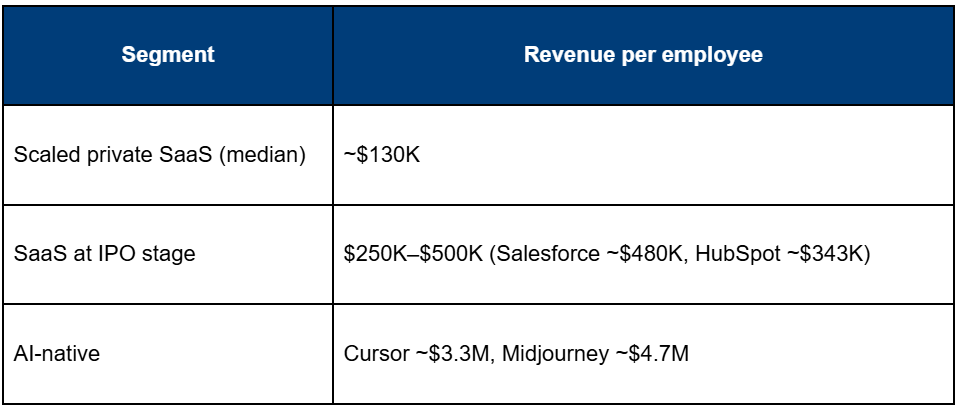
Estimates of the aggregate gap range from 4x to somewhere between five and ten times. That spread matters as much as the numbers do, so use the direction, not the multiple. AI-native teams are also shaped differently: roughly 40% smaller, reaching unicorn status about a year faster.
The adopter side is worse than vendor marketing implies
- Gartner: only 1 in 5 AI investments generates measurable ROI.
- MIT: 95% of pilots produced no measurable P&L impact.
- Morgan Stanley: only 21% of S&P 500 companies could cite a measurable AI benefit, while enterprise AI software spend is on track to nearly triple to $270B.
The honest framing: a small number of companies built around AI are posting extraordinary economics, while most companies bolting AI onto existing operations are spending heavily and struggling to prove a return. That second group is the majority. Being in it isn't a failure of nerve or talent. It's the default outcome of a specific set of structural conditions, which is the useful part, because structural conditions can be changed.
Why the gap exists
McKinsey found organizations seeing real returns twice as likely to have redesigned end-to-end workflows before selecting models. IDC found 88% of pilots fail to reach production, clustering on governance, data readiness and observability rather than model quality.
Read that as an org chart, because that's what it is. Nobody's AI initiative is failing on model access; everyone has that. They're failing on workflow redesign, data engineering and governance - people and process problems, and what successful adopters staffed for whether or not they named it that way.
One signal for build-vs-buy: vendor-led deployments succeeded roughly 67% of the time versus about a third for internal builds. That doesn't mean never build. It means an internal build is a bet on your own data engineering and governance maturity, and should be priced and staffed accordingly rather than assumed.
Which one are you?
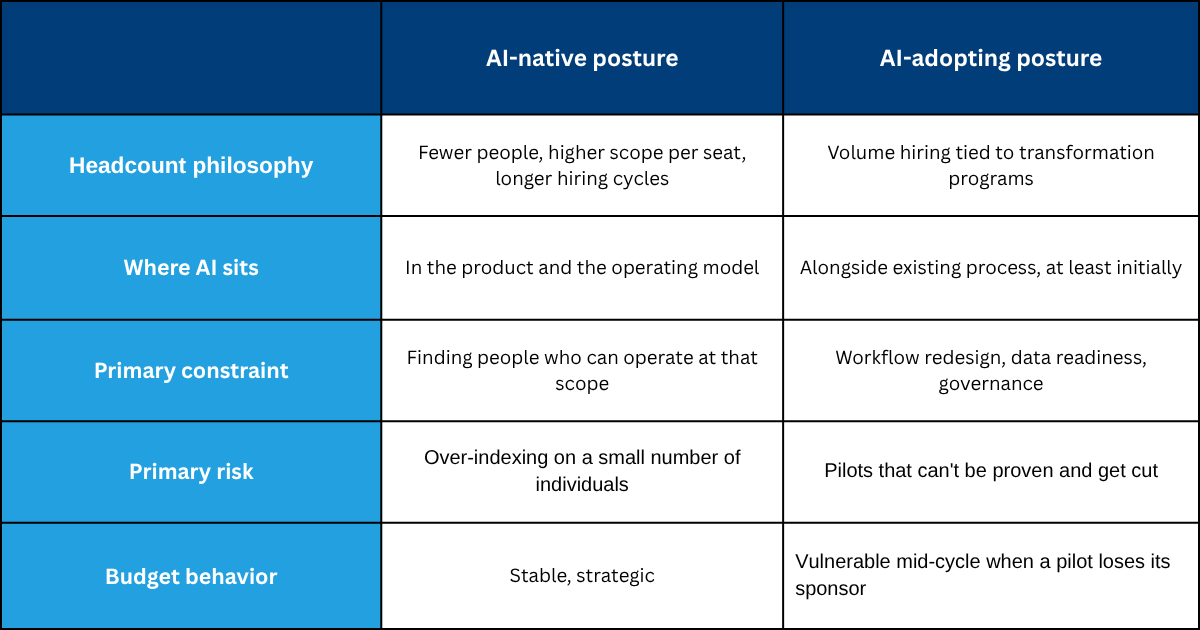
Most organizations are in the right-hand column. The goal of the rest of this document is to move you toward the left column's discipline without pretending you have its structure.
2.2 Strategy Versus Purchase
Building an AI strategy is not the same as buying AI tools.
A strategy starts with a business outcome, whether that's faster delivery, lower cost, or a new product line, and works backward to which capabilities, and which people, get you there. Too many organizations start with the tool and go looking for a problem to justify it.
The tell is usually the requisition. When a team can describe the technology in detail but goes vague on what will be different once it's working, there's a purchase in play, not a plan.
That distinction has a human cost. Strategy-led initiatives produce roles with clear scope, real ownership and staying power. Tool-led initiatives produce roles that get quietly deprioritized two quarters in, when the pilot loses its sponsor and the person you hired is left holding something nobody is accountable for. That person usually leaves within the year, and they tell people why.
The Three-Question Test
Run this on any AI initiative before it gets funded, including one you're sponsoring yourself. Clean answers to all three mean there's a strategy underneath. Hesitation on any one is worth naming out loud before money moves.
1. What outcome? "If this works perfectly, what's measurably different in twelve months?"
A strategy names a business result: cycle time cut by a third, support costs down by a specific amount. A purchase names an activity: "we'll be using AI in customer service." Push for the number someone would point to in a board meeting.
2. What changes? "Whose day-to-day work is different, and who decided that?"
Returns come from redesigned workflows, not layered tooling — reorganize 30% of a process around AI and you capture roughly 30% of the gain. If nobody's job changes, nothing has been redesigned. And an executive sponsor who has already agreed to the disruption is a fundamentally different setup than a technology team hoping to earn buy-in later.
3. What's measured? "What's the baseline, and who reviews the number?"
Most pilots launch without predefined success criteria, so there's no way to declare success even when the technology performs exactly as intended. Unprovable initiatives are the first ones cut when budgets tighten. A named owner reviewing on a set cadence is the strongest single predictor that an initiative survives past year one.
How to read the answers
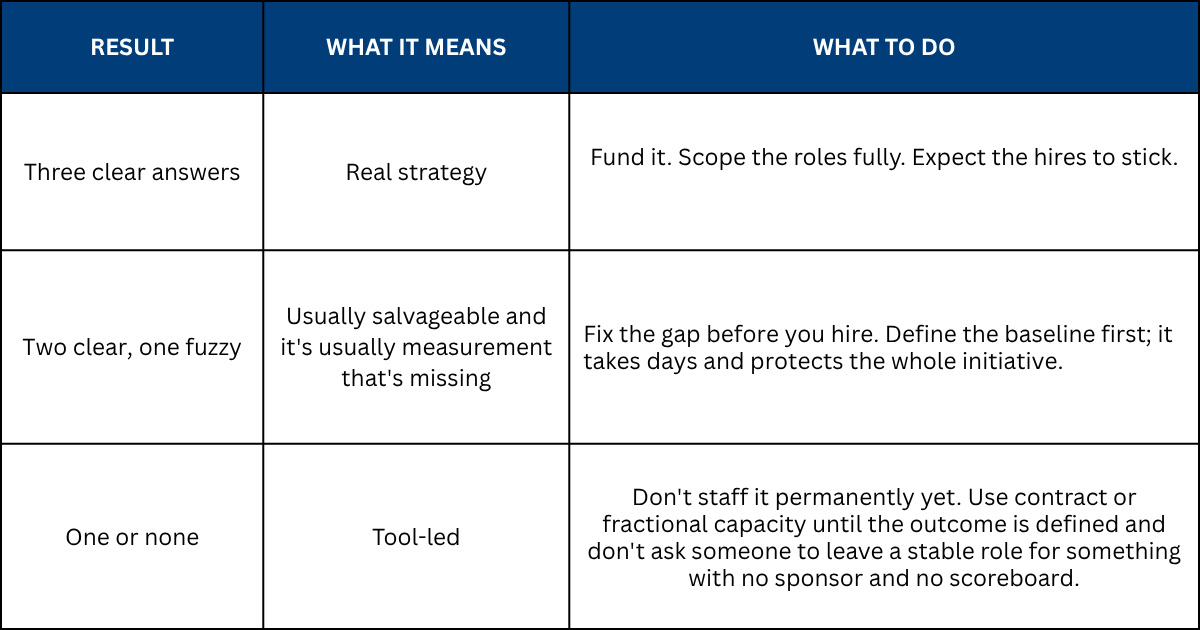
Download Now: Three-Question AI Initiative Readiness Test
2.3 Talent Tiers: Use, Build, Design
Think of AI talent like Lego. Some people use pieces someone else designed. Some build, assembling and customizing systems for a specific need. A smaller group designs the underlying models.
Most organizations need far more use-and-build talent than design talent and most are hiring, and paying, as if everyone needs to be a designer. Getting this ratio right determines your candidate pool, your search length, your comp bands, and whether the person is still there in eighteen months.
Builders — the technical backbone. ML engineers, AI researchers, data scientists. Their work is the mathematical and computational problem of getting systems to function at all. Small pool, long searches, top of band. Necessary if you are building models, rarely if you are deploying them.
Orchestrators — the business-technical bridge. AI product managers, implementation specialists, MLOps and platform engineers, governance and risk leads, solutions architects, evaluation specialists. They put an existing model to work: deploying, governing, scaling it.
This is where most adopting organizations are under-hired, and it maps almost exactly onto the failure modes in 2.1. If 88% of pilots die before production for those reasons, this is the tier that gets you to production.
Enhanced professionals — the business accelerators. Developers using coding assistants, analysts using automated insight tools, QA engineers running AI-powered suites. Sometimes dismissed as "vibe coders," but the ones worth hiring have the grounding to turn AI assistance into shippable product. Largest pool, fastest to hire, and the tier most likely to be filled by developing people you already employ.
A rough starting ratio. For a mid-size organization deploying rather than building: the bulk of your need sits in the Enhanced tier and is largely internal development. A meaningful and often under-planned investment goes to Orchestrators, largely external hiring. Builders only where you're genuinely creating novel technology. If your requisition list is weighted toward Builders and you are not building models, the plan and the org chart have come apart somewhere.
Chapter 3
The human element
3.1 Myth Versus Reality
Every wave of workplace technology arrives with a mythology attached. AI will replace entire functions. It's already better than your people at judgment work. If you're not automated, you're already behind. None of it holds up well against what's happening inside most organizations.
That gap is wide enough to be a competitive advantage. Organizations working from the headline version are over-buying tooling, under-investing in the judgment work that still determines outcomes, and planning against a market that doesn't exist. Organizations working from what's true are quietly outperforming them.
%20(1).png?width=1200&height=632&name=MYTH%20(Facebook%20Post)%20(1).png)
3.2 How Adoption Actually Works
Adoption isn't a single event. It's a sequence of smaller decisions: which process gets touched first, who owns the rollout, how success gets measured before anything scales. The pattern that works is narrower and slower on paper, and faster in practice.
1. Pick one process, not one department. High-volume, structured, measurable, short feedback loop. Ticket triage and routing in IT; resume screening, scheduling or policy Q&A in HR. Small enough that failure is survivable, specific enough that success is visible.
2. Establish the baseline before you touch anything. This is the step almost everyone skips, and it's why so many pilots can't be judged in either direction. What does this cost today in hours and dollars? How long does it take? What's the error rate? Without a number recorded before the change, there's no way to prove improvement later.
3. Name a single owner with authority to change the workflow. Not a committee, and not the person who evaluated the vendor. The returns come from redesigning how work is done, which requires someone empowered to tell a team their process is changing. A pilot owned by whoever had spare capacity runs alongside the old process instead of replacing it.
4. Define what success and failure look like before launch. Both. Kill criteria matter as much as success criteria, or the pilot limps along because nobody wants to be the one to call it. Set a review date.
5. Scale only after the first process holds. Expansion follows evidence, not enthusiasm. When the first workflow demonstrably works and its users advocate for it, that's your internal proof case. Those advocates are worth more than any vendor reference.
The recurring failure mode is treating adoption as a technology project when it is an operations project. Most of the work between pilot and production is data engineering, workflow integration, governance and measurement infrastructure. Very little of it is model selection. If your program plan and your staffing plan don't reflect that, they're planning for a different project than the one you're running.
3.3 Education: The Blocker Nobody Budgets For
The biggest adoption blocker usually isn't the technology. It's that the people expected to use it were never actually taught how.
Education has to happen at two levels. Leadership needs to understand why this matters and what it changes strategically; practitioners need to know how to use it day to day. These two audiences fail differently, which is why one training program rarely serves both.
Leadership failure looks like sponsorship without comprehension. An executive approves an initiative, can describe it at a high level, and then can't evaluate whether it's working, can't defend the spend when the CFO asks, and can't make the workflow changes it requires. Sponsorship that thin evaporates the first time a budget cycle tightens.
Practitioner failure looks like access without capability. Licenses get distributed, a launch email goes out, adoption looks fine for three weeks, then usage decays to a handful of enthusiasts. The people who were supposed to change how they work went back to how they worked before, because nobody showed them what better looked like in their specific job.
What good AI onboarding looks like
For leadership:
- Hands-on time, not briefings. A leader who has personally used the tools makes materially better decisions than one who has only been presented to.
- A working understanding of what the technology can't do. Overestimating capability produces failed initiatives; underestimating it produces missed ones.
- One financial metric they own and review on a cadence. Without a number attached to a name, the initiative has no defender.
- Enough fluency to distinguish a real vendor claim from a demo. Most AI purchasing mistakes are made in a room where nobody could evaluate what they were watching.
- Clarity on what organizational change is required, agreed before launch rather than negotiated after.
For practitioners:
- Training built around their actual work, not the tool's feature list.
- Explicit guidance on where the tool is unreliable and what has to be checked. People trust new tools too much or too little, and both are training failures.
- A clear policy on acceptable use, especially around personal data, candidate data, and anything touching an employment decision.
- A named person to ask when something goes wrong, available in the first few weeks.
- Follow-up at 30 and 90 days. The useful questions surface only after people have tried to use the thing for real.
- Permission to say it isn't working. Teams that can only report success will report success regardless.
The short version. Three questions get you most of the way there:
- Can leadership state the business outcome and the number they'll be judged by?
- Have practitioners been trained on their own work rather than on the tool?
- Is there a named person accountable when something breaks?
Anything less than three yeses, and the constraint isn't the technology.
Chapter 4
Hiring in this environment
Everything above eventually arrives at the same place: you need people who don't currently work for you, and the market you're hiring into has changed at least as much as the technology has.
This chapter is the practical one. It covers what's broken in hiring right now, and what to do about it.
4.1 The Problems
Synthetic candidates and identity fraud
Deepfake and AI-generated candidates aren't a future risk. Organizations are already encountering applicants using AI-generated video, voice, or entirely fabricated identities to get through screening. The commonly cited projection is Gartner's: one in four candidate profiles worldwide will be fake by 2028.
There's a detection problem underneath the process problem. A Greenhouse survey of 4,136 people found 31% had personally interviewed someone they suspected or confirmed was using deepfake technology, and 91% had encountered or suspected AI-generated answers during online meetings. A 2025 meta-analysis of 56 studies put human accuracy at detecting deepfakes at 55.54%.
The implication is uncomfortable but clear: this cannot be solved by telling interviewers to be more careful. It has to be solved in the process.
Workslop
A larger share of the volume problem isn't identity fraud. It's AI-generated applications that are polished, keyword-perfect and hollow — the candidate is real, the résumé describes someone who doesn't exist. In 2025, nine in ten HR workers reported a surge in these. It degrades screening not by slipping one bad actor through, but by making the entire top of the funnel less informative. Keyword matching stopped being a signal roughly the moment candidates could generate against it at zero cost.
It runs in both directions. Fake recruiters, fabricated postings and impersonated employers are targeting job seekers at scale. Your employer brand is an attack surface now, and candidates who get burned by someone using your name don't always find out it wasn't you.
FOMO
"Our competitors are already doing this" is a legitimate question, not a panic response — and the answer isn't always yes. If only one in five AI investments generates measurable return, the competitor who moved first is more likely than not to be in the group that spent money and got nothing. Watching is cheaper than doing, and a practice that has stabilized is faster and less expensive to adopt than one still in flux.
Three questions separate a real reason to move from anxiety wearing a strategy costume:
- Is their advantage visible in outcomes, or only in marketing? Organizations publicize AI adoption because it signals modernity, not because it worked.
- Would we be adopting a practice or buying a tool? If nothing changes about how we work, the purchase won't produce the outcome regardless of who else made it.
- What does waiting two quarters actually cost? Sometimes it's real — a client requirement, a compliance deadline. Often it's nothing measurable. Name the cost out loud and the urgency usually resolves itself.
4.2 What To Do About It
Verification that doesn't depend on video
- Verify identity before the assessment stage, not at offer. Verifying at the end means the entire evaluation may have been of the wrong person.
- Confirm reference contacts independently, rather than through details the candidate supplied.
- Run consistency checks across the digital footprint: account age, professional history continuity, whether the record predates the application.
- Where role and location justify it, hold final interviews in person. Gartner found 62% of candidates are more likely to apply when in-person interviews are required — so this costs less in pipeline than most teams assume.
Interview techniques that are hard to fake in real time. Train interviewers on these. They cost nothing and they work.
- Interrupt a prepared answer mid-flow with a follow-up that depends on what was just said. Scripted responses don't survive redirection.
- Ask about something visible in their environment.
- Ask them to sketch or diagram something and hold it up.
- Request a specific physical movement: turn fully in profile, pass a hand across the face, stand and step back from the camera.
- Ask about a failure. Fabricated narratives are optimized for achievement and go thin on specifics when a project went wrong.
- Follow up on a detail from three questions earlier. Impostors working from notes lose continuity.
- Embed a wrong answer: reference a technology or company detail incorrectly and see whether they correct you.
Deciding how much of interviewing to automate
"AI-assisted interviewing" covers an enormous range, from scheduling to full AI-led screening conversations. Where you land on that spectrum should match your risk tolerance and role type, not just what your vendor has available. It helps to treat it as four distinct levels:
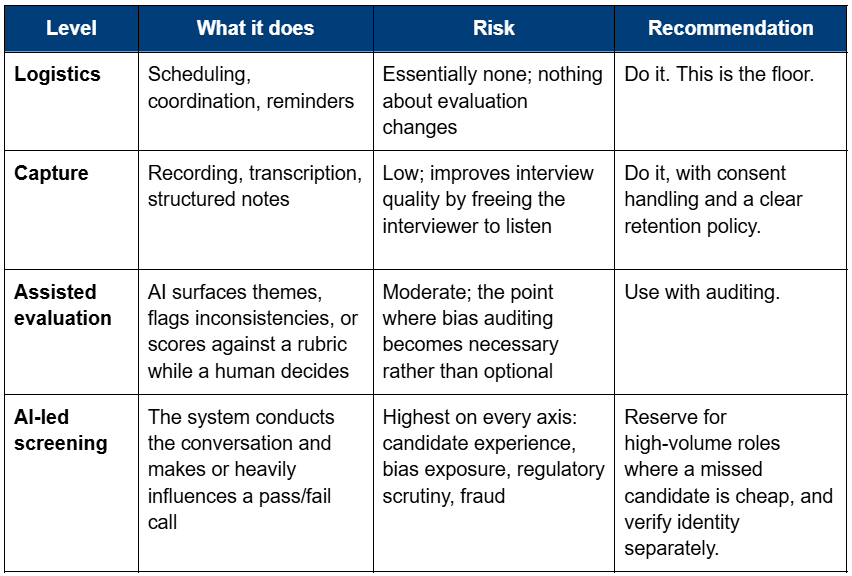
One point deserves emphasis, because it cuts against the prevailing direction of travel. Automating the screening conversation removes the human judgment that fraud detection depends on, at exactly the stage where fraud is most likely to enter. Organizations scaling AI-led screening while simultaneously worrying about synthetic candidates are working against themselves.
